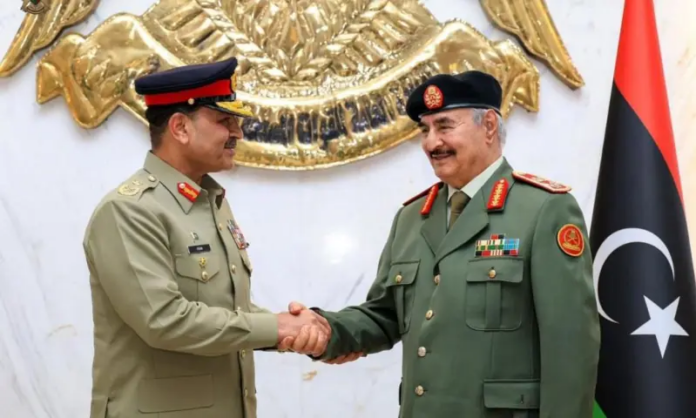


According to a news report by Middle East Eye, Pakistan has reportedly delivered weapons to Libyan forces of eastern Libya led by military ruler Khalifa Haftar, western and Arab officials familiar with the matter said. This delivery includes at least five cargo planes containing armaments that were unloaded at Benghazi Airport in March of this year, an official who witnessed the unloading of the armaments told the MEE. While another official confirmed that the delivery of armaments had taken place, he did not comment on what type of armaments were delivered.
The weapons delivery comes in the backdrop of a $4 billion deal that Haftar’s government secured with Pakistan back in December of last year, financed by Saudi Arabia. In a statement then, the Inter-Services Public Relations (ISPR) — the media and public relations wing of the Pakistan Armed Forces — reiterated that in a meeting with the Libyan Armed Forces’ commander-in-chief, it reaffirmed Pakistan’s commitment to strengthening defense ties with Libya, “based on shared interests”. Following this meeting, Khalifa Haftar along with his son Saddam — his likely successor — made a rare visit to Pakistan in February of this year to meet with Prime Minister Shehbaz Sharif and CDF Asim Munir, and it was likely here that the terms of the weapons delivery in March were discussed, as per an Arab official who told the MEE.
Following a civil war that raged on from 2014 until a ceasefire was reached in 2020, Libya is currently divided into two: an internationally recognized based in Tripoli and led by Prime Minister Abdul Hamid Dbeibeh, and a government based in Tobruk led by Commander-in-Chief of the Libyan Armed Forces Khalifa Haftar. Currently, there is a UN arms embargo imposed on Libya, though that has not stopped outside powers from supplying weapons to either faction in the country.
The arms deal came in the backdrop of the normalization of relations between Egypt and Turkey, and resultantly the deepening ties between Turkey and the Haftar-led government, as Haftar’s government is close to Egypt. It also comes in the backdrop of a deepening rift between Saudi Arabia and the United Arab Emirates (UAE) that has taken hold in recent years. Once close allies in the civil war in Yemen against the Houthis, relations between the two deteriorated over the latter’s heavy support of the Rapid Support Forces (RSF) in the ongoing civil war in Sudan. The RSF has committed numerous atrocities over the course of the war, most notably the genocidal massacre in El Fasher in October of last year when RSF paramilitaries massacred over 60,000 people, a massacre that was compared to the early phase of the Rwandan genocide in 1994.
Saudi Arabia lobbied the United States President Donald Trump against the UAE’s support of the RSF, leading to a decline in Saudi-UAE ties. Relations further deteriorated when UAE-backed forces in Yemen — the Southern Transitional Council (STC) — launched an offensive in December that resulted in them capturing most of the territory held by the Saudi-backed internationally recognized government by the end of the month. Their gains were reversed, however, when Saudi-backed forces launched a counter-offensive in January, and the counter-offensive continued until the government captured all of the territory that the STC previously held, including the temporary capital of Aden, which resulted in the dissolution of the STC.
Relations between Saudi Arabia and the UAE continued to remain sour during the ongoing Iran War that began on 28 February. Saudi Arabia for its part has balanced between American requests for bases and airspace on one hand and a negotiated settlement with Iran on the other hand, MEE states. The UAE for their own part have doubled down on hawkish stances against Iran and have been frustrated with the United States’ direct talks with Iran (facilitated by Pakistan).
In addition, the deal also comes as interest in Pakistan’s defense exports from other countries have risen since the conflict with India in May 2025, where Pakistan’s military — especially the Air Force — performed well and shot down numerous Indian fighter aircraft. The JF-17 Thunder, a fourth-generation fighter jet developed jointly by China’s Chengdu Aircraft Corporation and Pakistan’s Pakistan Aeronautical Complex, has garnered particular interest from foreign customers, particularly the 4+ generation Block 3 (or JF-17C) variant. Already in service with the Pakistan Air Force as well as with the air forces of Nigeria, Myanmar and Azerbaijan, the aircraft was included in the defense deal that the Haftar-led government of Libya signed with Pakistan, while countries like Bangladesh and Iraq were also in talks with Pakistan for potential future acquisition of JF-17 fighter jets, and others like Morocco expressing interest in the JF-17 as well. Reportedly Sudan was also in talks with Pakistan to acquire JF-17 fighter jets in a deal also reportedly financed by Saudi Arabia.