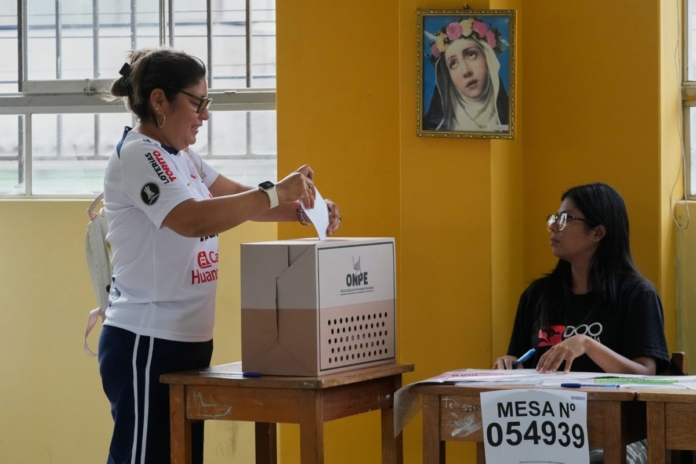


Peru held its first round of presidential elections on April 12, 2026, with voters choosing from a record field of 35 candidates to elect the country’s next president and a newly restructured bicameral Congress. The vote took place against the backdrop of a deep political crisis, with Peruvians seeking their ninth president in less than a decade, Al Jazeera reports. No candidate came close to the 50% threshold required to win outright, making a second round inevitable.
With 91.5% of votes counted, Keiko Fujimori of the Popular Force party leads with approximately 17% of valid votes and will advance to the runoff on June 7. (Americas Quarterly) Behind her, leftist congressman Roberto Sánchez ranked in second place with around 12 percent (Foreign Policy), narrowly edging out far-right candidate Rafael López Aliaga, who received approximately 11.9%.
Fewer than 30,000 votes separated Sánchez and López Aliaga (Americas Quarterly), making the race for second place one of the closest and most contested elements of the first round.
Who Are the Candidates?
Keiko Fujimori is the daughter of former President Alberto Fujimori, who governed Peru from 1990 to 2000. She has led his political bloc since 2010 and ran for president in 2011, 2016, and 2021, losing narrowly in the runoff each time (Americas Quarterly). Now, Fujimori has positioned herself as a guarantor of order and economic stability, promising to “restore order” in her first 100 days if elected. Her candidacy remains polarizing, as her father was convicted of human rights abuses and corruption before he died in 2024 (Al Jazeera).
Roberto Sánchez is a left-wing congressman who served in the cabinet of former President Pedro Castillo. He won votes in Peru’s poorer and more rural areas and has pledged to increase spending on health and education, legalize informal mining, expand state control over natural resources, and oversee constitutional changes to provide more public services for Indigenous Peruvians (Foreign Policy).
Rafael López Aliaga is a far-right entrepreneur and former mayor of Lima. He seized on logistical failures during the election to allege widespread fraud and called for the vote to be annulled (Americas Quarterly), a move that has since generated serious legal consequences (more on that below).
Election Day Chaos: Logistical Failures and Extended Voting
The April 12 election was plagued by significant organizational problems from the start. Dozens of voting stations were delivered late or not delivered at all, resulting in over 50,000 people being unable to vote. Peru’s National Office of Electoral Processes (ONPE) said it would reopen some polling stations after these logistical failures, and extended voting to April 13 in affected areas (Al Jazeera).
Fraud Allegations and Political Controversy
López Aliaga’s reaction to the results was swift and combative. He organized a demonstration demanding the invalidation of the election, accusing authorities of conducting “ballot box stuffing” to allow Keiko Fujimori to advance to the runoff. He also called for an “insurgency” if the elections were not invalidated.
Those statements had legal repercussions: after calling for an insurgency, López Aliaga faced criminal charges related to alleged incitement of civil disorder from Peru’s Public Ministry. He also offered 20,000 Peruvian soles to individuals who assisted his argument of electoral fraud.
International observers, however, pushed back on the fraud narrative. Despite the slow count, European Union observers said the contest appeared free of fraud.
What’s at Stake for the Runoff on June 7
The second round will pit Fujimori against Sánchez in what promises to be a highly polarised contest. Fujimori has lost three consecutive presidential runoffs, and the outcome remains uncertain (Americas Quarterly).
Sánchez’s relatively strong performance revealed that many Peruvians remain interested in a left-wing platform, even after former leftist President Pedro Castillo’s chaotic 2022 power grab that led to his impeachment (Foreign Policy). Castillo, currently imprisoned, endorsed Sánchez.
The broader national mood, as described by Peruvian political scientist Alberto Vergara, is one of “exhaustion in the face of an endless series of corruption problems” and a sense of “hopelessness, discouragement, and disinterest” (Foreign Policy).